
Rotobrush Air Duct Cleaning in Harvey Park: A Homeowner’s Guide
Vacuuming your ductwork without agitation is roughly like vacuuming a carpet without ever moving the vacuum. The surface looks addressed, but the embedded material stays put. That’s the gap Rotobrush was built to close, and it’s why the machine shows up in so much advertising while the actual mechanics stay unexplained. If you’ve been comparing duct cleaning quotes in Harvey Park and can’t tell what separates one crew’s equipment from another’s, this guide is for you. And if you’d rather skip the research and get a straight answer, call (833) 660-4969.
Here’s the short version: Rotobrush is a contact-cleaning system. It puts a spinning brush physically against the inside wall of your duct while a vacuum pulls loosened debris away at the same moment. Vacuum-only systems move air; Rotobrush moves material. Understanding that distinction tells you what to ask before you book anything, and it tells you when the tool is the right fit for your house and when it isn’t.
What is Rotobrush and how does it differ from vacuum-only cleaning?
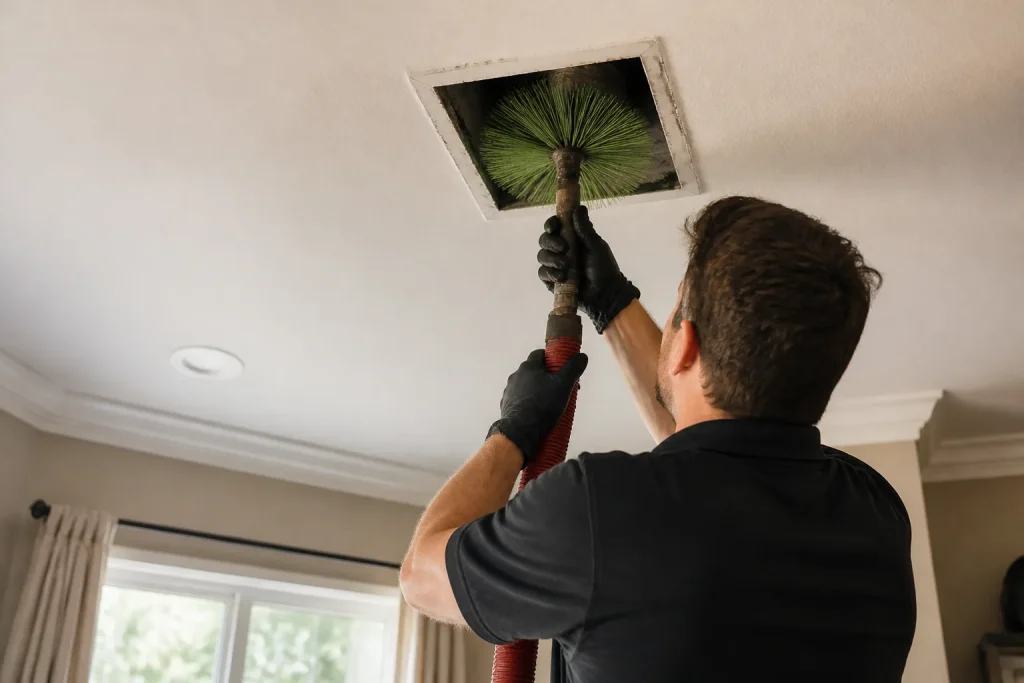
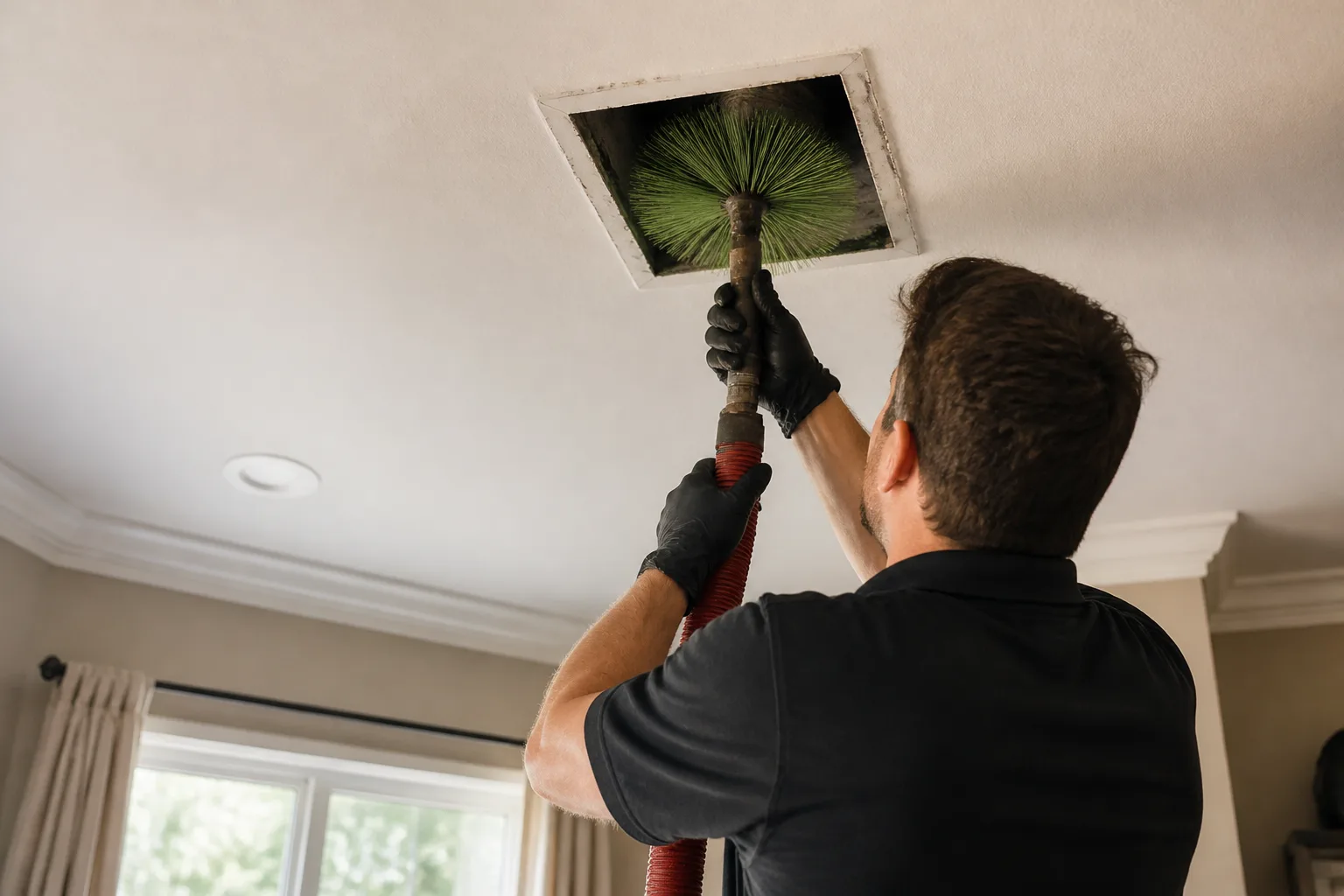
Rotobrush is a rotary brush-and-vacuum system that cleans ducts by contact rather than by airflow alone. A flexible whip with a spinning brush head travels through the duct run, scouring the interior surface, while a high-volume vacuum captures what the brush breaks loose. Negative-pressure-only systems, by contrast, rely on suction and air movement to lift debris from the duct walls. That works on loose dust. It’s much weaker on the adhered film of dust, lint and residue that builds up on the metal and flex surfaces over years of normal use.
Picture the difference in your kitchen. Wiping a counter with a wet cloth gets the loose crumbs. The baked-on ring around a burner needs something with friction behind it. Duct walls behave the same way. Airflow carries particles past a surface; it doesn’t necessarily remove what’s already stuck there.
Contact cleaning vs. airflow cleaning, side by side
- Mechanism: contact cleaning uses a rotating brush against the duct wall; airflow cleaning uses suction and air volume only.
- What it removes: contact cleaning dislodges adhered buildup; airflow cleaning captures loose particulate.
- Coverage: contact cleaning reaches the full circumference of the run as the brush head rotates; suction alone acts strongest near the vacuum inlet.
- Verification: contact cleaning produces visible before-and-after evidence inside the run; a vacuum-only pass is harder to verify from the outside.
That last point matters more than it sounds. When a job is done with a rotary system, the technician can show you what came out of the run and what the interior looks like afterward. Our Air Duct Cleaning Harvey Park work is built around that kind of visible result rather than a promise.
Which duct materials does Rotobrush work best on in Harvey Park?
Rotobrush is at its best on two duct types: standard sheet metal trunk-and-branch runs and modern flex duct. Both hold up well to a rotary brush head when the technician sets the right brush stiffness and feed rate. Harvey Park’s housing stock makes this a practical question rather than a theoretical one. The neighborhood’s mid-century ranch and split-level homes were built in an era when sheet metal ductwork was standard, and many of those runs are still in service today, sometimes with sections of flex added during a later furnace or air handler replacement.
That mix is exactly where technique matters. A technician cleaning Harvey Park homes has to read the duct before choosing the tool setting:
- Sheet metal: the most forgiving surface for rotary contact cleaning, and the easiest to inspect afterward.
- Flex duct: cleanable with a rotary system, but the brush speed and head size need to match the duct’s inner diameter so the liner isn’t stressed.
- Older or damaged runs: where there’s a tear, a collapsed section or a joint that’s already failing, the technician adjusts the approach or flags the section for repair rather than forcing a brush through it.
- Duct board: a softer interior surface that calls for a gentler pass to avoid abrading the lining.
This is the part of the job that separates a trained hand from a rented machine. A rotary brush is powerful, and power applied without judgment is how duct liners get damaged. Ask any company you’re considering how they assess duct condition before they start. The answer tells you a lot.
What does a Rotobrush cleaning actually look like from start to finish?
A typical Rotobrush cleaning starts with an inspection and ends with a verification walkthrough, and most of the job happens out of your sight inside the ductwork. Here’s what to expect in a Harvey Park home, in order:
- Inspection and setup. The technician walks the system, locates the main trunk, the branch runs and the return side, and identifies access points. Floor registers and some ceiling vents get removed so the brush can enter. Drop cloths go down.
- Negative air and containment. A vacuum source is connected to create negative pressure in the system so loosened debris travels toward the collection point instead of into your rooms.
- Contact cleaning. The rotary whip feeds through each run, brush head spinning, working the full length of the duct before being pulled back. Trunks get swept, then branches.
- Collection and inspection. Debris ends up in the vacuum’s collection container. The technician checks the runs and confirms coverage.
- Reassembly and walkthrough. Registers go back on, and you get a look at what was removed and the condition of the interior.
What you’ll hear is a steady mechanical hum from the vacuum with a soft, rhythmic sound from the brush as it travels. Expect a few hours for a whole-house job, longer if the system is large or heavily soiled. Nothing about the process is violent, but it is thorough, and thorough takes time.
Why does mechanical cleaning have to come before sanitizing?
Sanitizing a dirty duct is like painting over a dirty wall. The coating goes on, but it bonds to the grime instead of the surface, and the grime is still there underneath. Antimicrobial application works the same way. Its job is to treat the surfaces it contacts, and a surface covered in adhered dust, lint and residue is not really being contacted. Mechanical cleaning first, sanitizing second, is the only order that makes sense.
This is where equipment class matters. Rotobrush handles the contact cleaning. For the sanitizing step, the same class of filtration equipment used in commercial remediation work, including Abatement Technologies negative-air units, lets a technician control airborne particulate during the application instead of simply spraying and hoping. Nikro professional-grade tooling rounds out the setup on the heavier commercial-style duct work. The combination means the cleaning and the treatment are part of one workflow rather than two separate visits by two separate companies.
For Harvey Park homeowners dealing with musty odors or allergy flare-ups, the sequence is the point. If a company offers to sanitize without cleaning first, ask why. There’s rarely a good answer.
What will Rotobrush cleaning actually improve, and what won’t it fix?
Rotobrush cleaning measurably improves two things: the particulate load inside the duct system and airflow through it. Less material adhered to the duct walls means less material to be carried into your living space, and a cleaner, smoother duct interior means the blower moves the same volume of air with less resistance. That second effect is why cleaner ducts help your HVAC equipment work less to do the same job. It’s a real efficiency gain, not a marketing number.
What cleaning will not do is fix mechanical problems. Be skeptical of anyone who implies otherwise:
- Leaky duct joints still leak after cleaning. They need sealing.
- Crushed or kinked flex duct restricts airflow no matter how clean it is. It needs replacing or rerouting.
- Undersized return ducts are a design issue. Cleaning doesn’t change duct sizing.
- Failing insulation or disconnected runs need repair before cleaning has anything to protect.
This is why we treat cleaning and repair as one workflow. Five services under one roof, from air duct cleaning through repair and sealing, means the problem found during cleaning gets fixed instead of handed off. Our technicians have up to 12 years of experience reading exactly these situations.
When to call a pro
If you’ve noticed dusty registers that come back within days of wiping, a musty smell when the system kicks on, or a jump in energy bills without a change in how you use the house, those are reasonable signals to have the system looked at. So is a visible dust trail around a return grille, or a dryer that takes two cycles to dry a load. None of that requires a rotary machine in your hands. The brush head is a professional tool with real force behind it, and used wrong it can damage duct lining or, on older systems, get jammed in a failing run. This is skilled work, and the trained hand matters.
Related services in Harvey Park: along with dryer vent cleaning, which handles a documented fire risk in its own right, and HVAC cleaning for the coil and blower side of the system, the point is that the whole air pathway gets addressed rather than one segment of it.
The Bottom Line
Rotobrush is the right tool when you want duct walls actually cleaned rather than air passed over them, and it’s the standard professional approach for a reason. What to walk away with from this guide:
- Contact cleaning removes adhered buildup; vacuum-only cleaning handles loose particulate. Know which one you’re being quoted.
- Duct material and condition determine technique, and Harvey Park’s mix of older sheet metal and later flex runs is exactly why a trained eye matters before the brush goes in.
- Sanitizing only works after mechanical cleaning, never instead of it.
- Cleaning improves particulate load and airflow. It doesn’t fix leaks, crushed flex or undersized returns, so hire a company that can repair what it finds.
If you’re in Harvey Park and need help, Air Duct Cleaning Harvey Park offers free estimates. We don’t just clean your ducts; we inspect, repair, seal and sanitize the full system using the same professional-grade equipment commercial contractors rely on, and you get before-and-after photos of your own ducts plus one flat price per system agreed before work starts. Call (833) 660-4969. We answer 24/7. Fast dispatch from 7am to 7pm, Sunday through Friday.
Frequently Asked Questions
Rotobrush is better at removing adhered material because it physically contacts the duct wall, while negative-pressure systems rely on suction and air movement alone. In practice the two work together: a proper whole-house job uses negative pressure to contain debris and a rotary system to dislodge it. A quote that mentions only suction is describing airflow cleaning, not contact cleaning. Call (833) 660-4969 for an exact quote; estimates are free.
Most whole-house jobs run a few hours, depending on system size, number of runs and how heavily soiled the ducts are. Older ranch and split-level homes in Harvey Park sometimes have longer trunk runs that take extra passes, and any runs flagged for repair add time. Setup, cleaning and the verification walkthrough are all part of that window. Call (833) 660-4969 to talk through your system; estimates are free.
Not in trained hands. The risk comes from using the wrong brush stiffness or feed rate on soft or damaged duct, which is why a technician assesses the duct condition before cleaning and adjusts technique for older or failing runs. This is also why we don’t recommend renting a rotary machine for DIY work. If a run is already damaged, it gets flagged for repair and sealing rather than forced. Call (833) 660-4969 for an assessment; estimates are free.
You should see before-and-after photos of your own ducts, not stock images, and a look at what was collected in the vacuum container during the job. Ask for the walkthrough before you pay. A company confident in its work will show you. Call (833) 660-4969 to book an estimate; estimates are free.
Written by the team at Air Duct Cleaning Harvey Park.
Need Air Duct Cleaning Help?
Call Air Duct Cleaning Harvey Park - the local pro we connect you with is licensed and insured, with free written estimates in Harvey Park.
(833) 660-4969